


 j
jConfigure WebSockets
REST Wrappers for SFAP APIs
Using Key-Value Stores for Secure Data Storage
Dark Mode and Dark Theme Settings
In-App Developer Support
Mobile SDK 6.0 introduces several new screens in native apps for debugging during app development. These features usually do not require coding and are designed for debug builds.
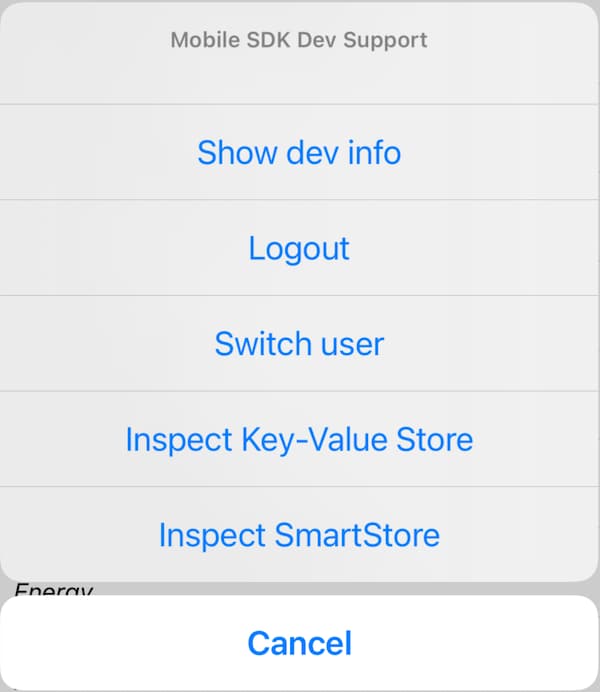
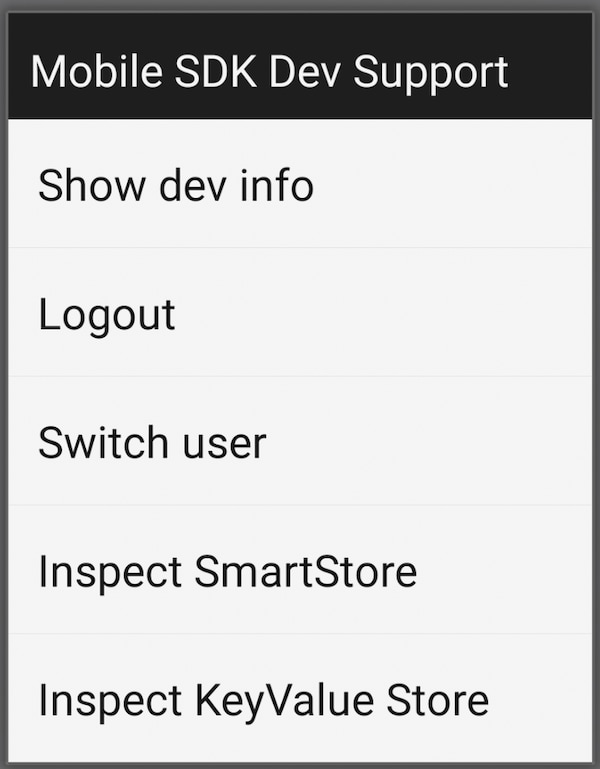
The Dev Support dialog box is the launchpad for all available support screens. The dialog box presents only the options that are pertinent to the type of app you’re running. During debugging, you can access the Dev Support through a keyboard shortcut or gesture.
By default, these tools are enabled in debug builds only. However, if necessary, you can use an SDK call to enable or disable the tools in production builds.
iOS
To launch the Dev Support dialog box, use one of the following options.
^+Command+z keyboard shortcut.Here’s the iOS screen.
Android
To launch the Dev Support dialog box, use one of the following options.
Command+m (Mac) or Ctrl+m (Windows) keyboard shortcut.adb shell input keyevent 82Here’s the Android screen.
If you require the Developer Support tools in production builds, set the property that indicates Dev Support is enabled. This use case is unusual.
iOS
1// To enable
2[SalesforceSDKManager sharedManager].isDevSupportEnabled = YES;
3// To disable
4[SalesforceSDKManager sharedManager].isDevSupportEnabled = NO;
Android
1// To enable
2SalesforceSDKManager.getInstance().setDevSupportEnabled(true);
3// To disable
4SalesforceSDKManager.getInstance().setDevSupportEnabled(false);
Don’t forget to disable the feature before distributing your app to the public.
Important
The Dev Support dialog box presents options based on the app type. In every case you get:
bootconfig file and recompiling the application. Clicking this button opens a menu with the following configuration and inspection sections:
bootconfig.xml. On Android, contents are read-only. On iOS, you can modify values, which to achieve the same effect as modifying bootconfig.xml for the session.bootconfig file.Inspect SmartStore—Displays the SmartStore inspector screen.
SmartStore inspector is useful during development because it decrypts the data for display purposes. This decryption applies only to the inspector display—data remains encrypted on disk.
React native dev support—The React Native dev menu.
The Dev Info screen shows a collection of information about the app, its configuration, and so on, based on the app type. In every case you get:
For SmartStore apps, you get the following additional information:
The SmartStore Inspector screen is a legacy feature that lets user see a list of SmartStore soups and their indices, and run custom queries. In Mobile SDK 6.0, this screen adds a store picker that lets you choose which global or user store to inspect.
The Dev Info screen gets the information shown in its screen from a method named getDevSupportInfos in SalesforceSDKManager. Some subclasses of SalesforceSDKManager override this method. To show your own custom information, you can also override it. To do so, implement a subclass of SalesforceSDKManager, override the method, and use it in your application.
iOS
1/**
2  * @return Array of name1, value1, name2, value2, etc.) to show in SFSDKDevInfoViewController
3  */
4- (NSArray*) getDevSupportInfos;
Android
1/**
2  * @return Dev info (list of name1, value1, name2, value2, etc.) to show in DevInfoActivity
3  */
4public List<String> getDevSupportInfos();
We've Moved
j